In this episode of the Empower Students Now Podcast, your host, Amanda Werner, delves into the practice of Metta or Loving Kindness Meditation. As part of an eight-part series on meditation and mindfulness for teachers and students, Amanda shares insights from her extensive teaching career and her training as a meditation teacher. She explains the steps to practicing Metta, including starting with those easiest to love, and expanding outward. Additionally, Amanda reads poignant quotes from Sharon Salzberg’s book, ‘Loving Kindness, the Revolutionary Art of Happiness,’ and discusses the importance of boundaries and compassion. The episode concludes with a guided meditation designed to help listeners cultivate loving kindness and a compassionate mindset. Listeners are encouraged to share the podcast, visit Amanda’s website, https://amandawritenow.com for additional resources, and reflect on their experiences with the series.
00:00 Introduction and Podcast Support
02:52 Episode Introduction: Loving Kindness
05:07 Understanding Metta: Loving Kindness
08:44 Personal Stories and Challenges
15:03 Steps to Practicing Metta
18:11 Guided Meditation on Loving Kindness
Support the podcast and engage your students with Amanda’s creative curriculum. Written, designed, and tested in real classrooms!
-

Truth or Dare for the Classroom
$6.00 -
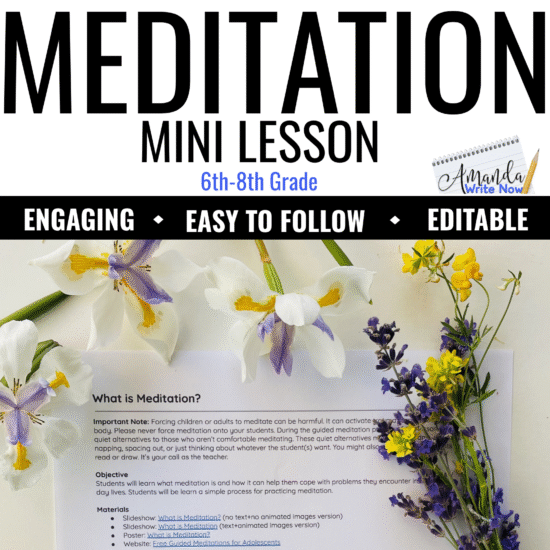
Meditation Mini Lesson 6th-8th Grade
$5.00 -
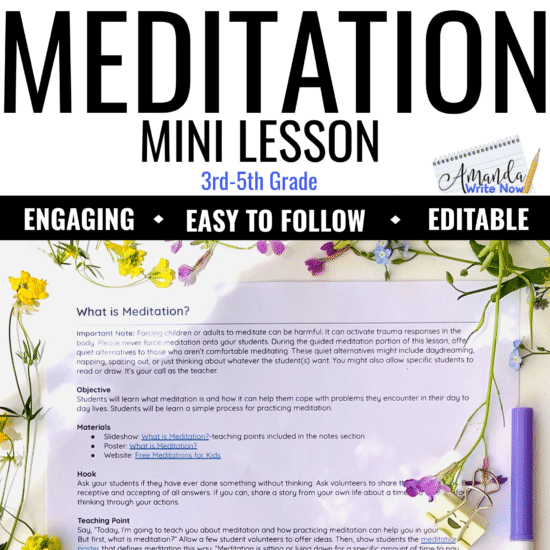
Meditation Mini Lesson 3rd-5th Grade
$5.00 -
Sale!

Middle School Engagement Bundle
Original price was: $212.50.$132.00Current price is: $132.00. -

Memoir Writing Unit
$20.00 -

Journal Writing Unit
$15.00 -
Sale!

Argumentative Writing Unit
Original price was: $23.00.$18.00Current price is: $18.00. -

Digital Citizenship Posters
$2.25 -

Mafia Game
$6.00 -

How to Find a Good Book Mini Lesson
$2.75 -
Conferencing with the Teacher Mini Lesson
$2.75 -
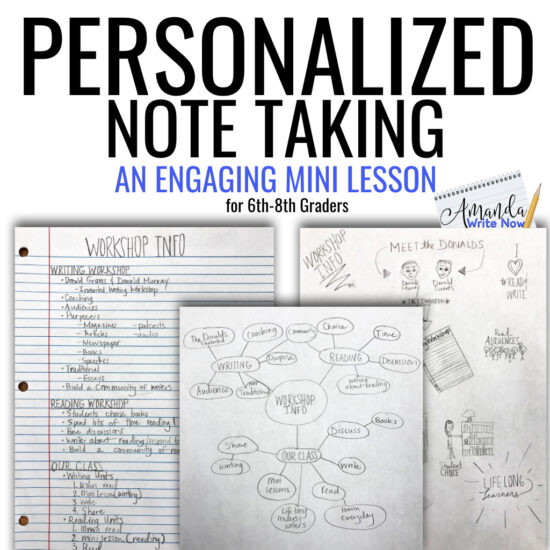
Personalized Note Taking Mini Lesson
$2.75
Transcript:
Amanda: [00:00:00] Thank you for listening to the Empower Students Now Podcast. I am Amanda Werner, the host of this podcast. I’ve been a teacher for 16 years, and I’ve had this podcast since 2018. It’s evolved and changed a lot because times have changed. I would love to let you know about some of the ways you can support this podcast and the work that I do.
There are many options. So first of all, you could purchase one of my resources. I create engaging lessons units. Games, simulations, projects. I have all sorts of resources, and you can find them@amandarightnow.com. You can also find resources related to each episode in the show note. The most recent product that I’ve [00:01:00] created is a meditation mini lesson poster and Google slideshow.
I love creating mini lessons that are easy to follow and super engaging for students. Each mini lesson has a hook materials, and all the materials are included and they are often editable. Uh, there’s a teaching point that’s very straightforward and clear for students. There’s a modeling component, guided practice, and independent practice.
This new meditation mini lesson resource includes a Google slideshow that’s editable, and an eight and 11, eight and a half by 11 inch poster that defines meditation for students that you can print out and post in your classroom. Go ahead and look in the show notes to find links to this lesson so you can look inside and learn more.
You can [00:02:00] also write a review on Apple Podcasts. This grows podcasts. The more reviews I have. The more that my podcast will rank on Apple Podcast and more people will be able to benefit from the work that I’m doing. You can also share a link to my podcast with a friend. That helps too. Thank you so much for your support.
I appreciate you and let’s go ahead and get to the episode now.
Hi. Today’s episode is about meta or the practice of loving [00:03:00] kindness. This is part six in an eight part series, all about meditation and mindfulness for teachers and students. You can take anything from the series and bring it to your students in every episode. I. Have a 10 minute talk and then a 10 to 15 minute guided meditation, and these guided meditations are hopefully calming and relaxing and helpful for you.
I’m recording this this summer of 2025, and it’s almost the end of July, which means a lot of teachers are going back to school soon. Which can be a really challenging time, and so hopefully these, uh, episodes are helping you through, uh, [00:04:00] stressful times. Maybe they’re helping you get ideas for tools to use for future stressful times, so you can always go back and listen to parts one through five.
They’re just the previous episodes from this one. And I hope you do, because they really are. They capture the basics of what mindfulness and meditation are and how they can help you in your day-to-day life. And everything I’ve learned, I. Everything I’m teaching you is from a program that I completed a two year program to become a meditation teacher.
So I’m a meditation teacher now, which is really exciting, and this is the way that I am sharing what I’ve learned through this podcast. So I appreciate you taking the time to listen and share with other colleagues [00:05:00] or friends or family members if you find it helpful. So let’s begin this. Talk about Metta.
Metta is, has a very long history and has been practiced by many different traditions, uh, Buddhist traditions and, but it can also be secular and. I think that it’s really what a lot of people need right now, especially because there’s so many conflicts between people right now, like just with different value systems, different beliefs, different um, just solutions that they have for the problems that the world is facing, right?
Everyone has their own viewpoints, their own political opinions, and. [00:06:00] Also there’s just conflict, you know, day-to-day conflict with family members, spouses, kids, our students. And I’ve found that this practice can be really, really helpful, uh, to gain perspective and just to regulate our own nervous systems.
So what is meta? Uh, and it’s M-E-T-T-A Metta, or also called loving Kindness is unconditional kindness that flows from the heart and an unending wish for the wellbeing of all. Beings without discrimination or preference. In essence, Matta is the art of holding the world in a [00:07:00] loving gaze, seeing the sacred in the ordinary, and offering the gift of our deepest, most sincere goodwill to all beings near and far.
And, and this can be practiced even towards your enemies, people that you really. Just don’t know if you can ever love, and it, it can be just a very cathartic experience, but it can also be really, really challenging to do that. So take it slow. Um. And I would like to read a quote from someone, uh, who’s really famous for writing about loving kindness and meta.
Uh, her name’s Sharon Salzberg and she wrote a book called Loving Kindness, the Revolutionary Art of Happiness. And she defines meta this way. Meta is the ability to embrace all parts of [00:08:00] ourselves. As well as all parts of the world. Practicing meta illuminates our inner integrity because it relieves us of the need to deny different aspects of ourselves.
We can open to everything with the healing force of love. When we feel love, our mind is expansive and open enough to include the entirety of life and full awareness. Both its pleasures and its pains. We feel neither betrayed by pain or overcome by it, and thus we can contact that which is undamaged within us regardless of the situation.
And I’ll just tell you a short, maybe a couple of stories just from my own. Personal life and just how Meta has helped me through it. Um, there I have, well, [00:09:00] this summer I’ve had multiple conflicts with people that are very, very close to me. Um, and they’ve been really hard conflicts, just not being able to see, um.
Eye to eye and just feeling like disconnected and feeling misunderstood, even betrayed, even feeling betrayal. Um, and those feelings are, are, you can get really sucked into them. Uh, and you can feel like. You want to turn away from these hard feelings and this relationship with this person, and I mean, you have every right to, especially if someone’s betrayed you, but it, it can be, um, divisive, right?
These kinds of conflicts with people in our lives. And I’m not, I, I don’t wanna name specifics of things that have happened, but. [00:10:00] Even just yesterday, I had a really hard conversation with a family member and we really differ in our, uh, political views and I felt very hurt, uh, by some of the things that this family member said to me.
Um, I felt, um. Like they were judging me and that they were calling me names. Really. I mean, they were, they were calling me names, you know? And so I feel a lot of resent resentment. I feel a lot of sadness. Right? Disconnection. And um, when you practice meta, you sort of step out of your own. Situation, your own, the conflict that you’ve had with this person or these people, and you sort of, uh, become more aware of the bigger picture of [00:11:00] things.
And, um, it, it really is sort of hard to describe the feelings you can get when you start to see the humanity in another person and you start to. Um, send them well wishes and peace and kindness and love and just see that they’re a human just like you, who just wishes to be happy. And so do you see the difference between, you know, when you’re in a conflict with someone and.
Really entrenched in what happened, and you’re maybe replaying it versus what I just described. And it can take time. You know, like it’s, it’s important to, to let yourself grieve, um, or feel pain from a conflict. I’m not saying that, that you should turn away from that. And I actually have a quote kind of about that.
Like, isn’t, isn’t meta and loving [00:12:00] kindness isn’t that being passive and letting people walk all over you? No, it’s not. Um, I. It’s not. And so I will read you this, uh, this quote, and it’s also from Sharon Salzberg, uh, about this topic of, of kind of being sort of a doormat door map, Matt, which is some people talk about meta as like that’s kind of what you’re letting happen.
This is what Sharon. Salzberg says, sometimes we think that to develop an open heart, to be truly loving and compassionate means that we need to be passive to allow others to abuse us, to smile and let anyone do what they want with us. Yet this is not what is meant by compassion. Quite the contrary.
Compassion is not at all weak. It is the strength that arises out of seeing the true nature [00:13:00] of suffering in the world. Compassion allows us to bear witness to that suffering, whether it is in ourselves or others. Without fear, it allows us to name injustice without hesitation and to act strongly with all the skill at our disposal.
To develop this
kind state of compassion end mind, state of compassion is to learn to live as the Buddha put it with sym sympathy for all living beings without. Exception. So you know, you, you can stand up for yourself. You know, you can within your own mind and heart. Draw boundaries around people, not share certain things with people.
You know, this person that I had this conflict with in my [00:14:00] family, I realized that I need to. Be careful about the things that I say, um, and talk about with this person because I can’t always share my true opinions with them. You know, and you kind of have to figure out for yourself like your own boundaries.
And you don’t have to tell anyone those boundaries if, if you don’t want to, you know, they can just be within, right. But that doesn’t mean that you can, you know, you’re gonna have sort of like a cold heart towards them. You can still feel loving kindness towards, um, people and others that. You feel resentful towards or you feel like they’ve hurt you terribly.
And you know, this does sort of relate with forgiveness, and that’s a whole other topic [00:15:00] that maybe I’ll do a, an episode on. But, uh, to end this talk, I’ll just tell you the steps to practicing meta, and then I will guide you in a. Uh, a meditation, uh, involving practicing loving kindness meta. So the first step is to start with comfort.
Make sure you are comfortable, and that really goes for any time you meditate. It’s, it’s important to, to lay down, lie down, or to just sit with back support. You know, don’t, don’t sit in a position that’s gonna be really uncomfortable. That’s not necessary. And then the, the second tip I have is to begin with.
Whoever’s easiest to love. This could be a pet, a child, um, someone that is just really loving towards [00:16:00] you. And so it’s just easy, you know, it’s easy to send them, love loving kindness and well wishes. And then once you start with that easy person, um, and usually it’s not yourself, right? Like it’s usually we’re not the easiest loving ourselves is actually.
One of the hardest things to do. And if you have a hard time with that, I recommend you go back and listen to the episode about, uh, compassion, self-compassion. But then the third thing that you would do, um, is to expand gradually outward from that person who’s really easy to love and move from loved ones.
Um, in your circle, like friends, you feel close with family members, you feel a lot of love from. And then you kind of move outward from there to p maybe acquaintances, the, you know, the, the mail person that brings your mail, the grocery, uh, cashier, whoever, like people that [00:17:00] you see regularly, but you maybe don’t know, and then you.
Um, expand it even further to, um, people that you don’t know, just, you know, all beings. And you can also send well wishes and loving and kindness to people that you really, really can’t stand and maybe even are your enemies. And, uh, what a, a wonderful way to. Sort of, um, I guess cleanse yourself of negative feelings is this practice of loving kindness and meta.
Um, so let’s, let’s practice, let’s try this out. I hope that you’ll stay and, uh, participate in this guided meditation on meta loving kindness.[00:18:00]
As we begin this meditation practice of loving kindness, bring your attention to your breath. Let your body relax.
Breathing in through the nose
and out through the mouth.
Scan your body.[00:19:00]
Starting with your head
notice.
You notice parts of your body that don’t really get much attention. Maybe your ears,
your eyebrows.
Let them relax.
Notice the sensations in your mouth
and just continue [00:20:00] scanning down slowly.
Noticing places that feel peace and calm and neutrality,
maybe places that feel tight.
Send love. Relaxation, peace to those tight areas. Breathe into them.[00:21:00]
As we turn inward,
it’s best to begin directing, loving kindness to those you love. People that are easy to love
right now. Picture or imagine someone you love a lot. Someone where love comes. Easily,
it’s uncomplicated.
Start first
with this person or pet to open your heart.
Breathe gently[00:22:00]
and recite inwardly the following traditional phrases directed toward their wellbeing.
Tell them, may you be filled with loving kindness.
May you be safe. From inner and outer dangers,
may you be well in body and mind.
May you be at ease. And happy.[00:23:00]
As you repeat these phrases, hold this loved one in loving kindness. Open your heart,
sending this kind intention to them over and over, letting the feelings. Permeate your body and mind.
Sometimes this meditation may feel awkward or mechanical. It might even bring up feelings of irritation or anger.
If this happens, it’s important to be patient and kind towards yourself, allowing whatever arises to be held in a spirit of [00:24:00] friendliness and kind affection.
Now, I’d like you to picture a second person or being animal. This, this being is easy to love.
Repeat these phrases gently no matter what arises. The rule and loving kindness practice is to follow the way that most easily opens your heart,
envision or imagine these two beings that you’ve chosen. Gazing back at you with the same well wishing [00:25:00] they want you too. To be held in kindness. To be safe and happy. Picture them saying this to you kindly.
May you be filled with loving kindness.
May you be safe from inner and outer dangers.
May you be well and mind and body.
May you be at ease and happy.
Receive these wishes gratefully,
you might even place your hand on your heart[00:26:00]
and say to yourself, in these beings you love so dearly,
may we be filled with love and kindness.
May we be safe from inner and outer dangers?
May we be well and body and mind.
May we be at ease. And happy
coming back into the space. Around you
noticing [00:27:00] sounds,
your body, your fingers.
All right. Wiggle your toes, wiggle your fingers. Bring yourself back.
Notice your heart beating if you have your hand on your heart.
And when you feel ready.
It can open your [00:28:00] [00:29:00] eyes.
0 Comments