In the final episode of this eight-part mindfulness and meditation series, Amanda Werner brings it all together—sharing how to weave mindfulness, self-compassion, and simple rituals into your daily life. From experimenting with small, accessible practices to cultivating deep calm and balance (equanimity) amidst stressful lives, this episode offers practical wisdom and heartfelt reflection for teachers, parents, students, and anyone seeking peace in a busy world.
Amanda also shares personal updates about her journey away from the classroom, homeschooling her daughter, and navigating life with chronic pain—all while finding ways to stay grounded and openhearted.
What You’ll Learn in This Episode:
The four keys to sustaining mindfulness: experimentation, ritual, equanimity, and self-compassion.
How to create simple rituals that bring grounding and meaning to your day.
Why equanimity—calm in the midst of chaos—is the heart of a sustainable mindfulness practice.
Ways to integrate mindful breathing, body awareness, and compassionate self-talk into your work and home life.
A guided meditation to help you embody balance, presence, and peace.
Timestamps
00:00 – Welcome & updates on Amanda’s journey
04:00 – Series recap: seven practices that build a foundation for mindfulness
20:00 – The four pillars to incorporating these practices: experimentation, ritual, equanimity, and self-compassion
35:00 – Guided meditation for balance and presence
Support the podcast and engage your students with Amanda’s creative curriculum. Written, designed, and tested in real classrooms!
-

Truth or Dare for the Classroom
$6.00 -
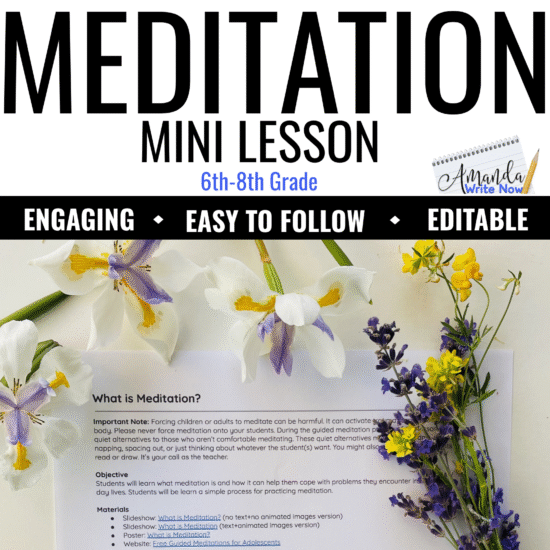
Meditation Mini Lesson 6th-8th Grade
$5.00 -
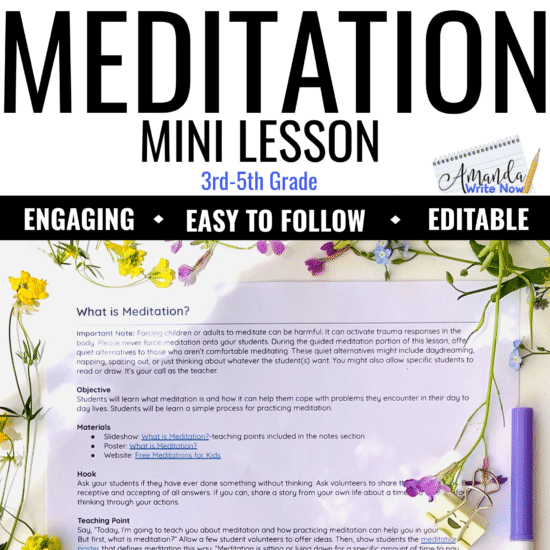
Meditation Mini Lesson 3rd-5th Grade
$5.00 -
Sale!

Middle School Engagement Bundle
Original price was: $212.50.$132.00Current price is: $132.00. -
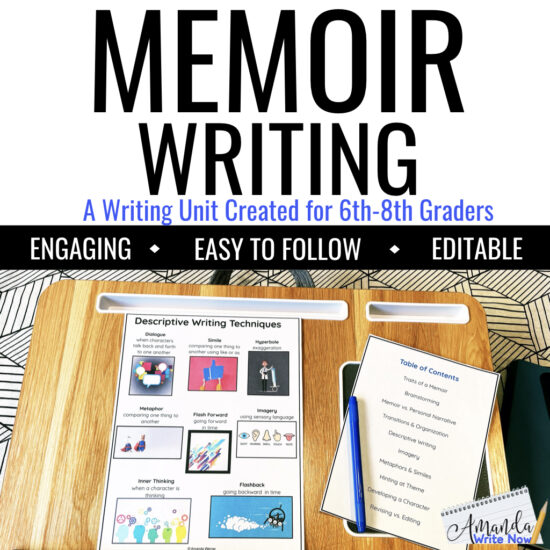
Memoir Writing Unit
$20.00 -

Journal Writing Unit
$15.00 -
Sale!
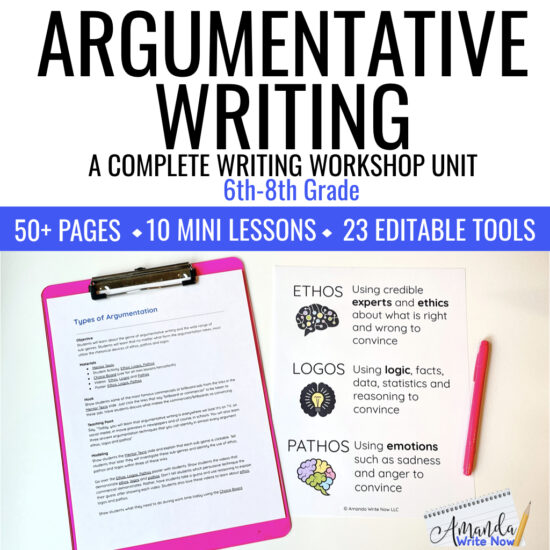
Argumentative Writing Unit
Original price was: $23.00.$18.00Current price is: $18.00. -

Digital Citizenship Posters
$2.25 -

Mafia Game
$6.00 -
How to Find a Good Book Mini Lesson
$2.75 -
Conferencing with the Teacher Mini Lesson
$2.75 -
Personalized Note Taking Mini Lesson
$2.75
Transcript:
Amanda: [00:00:00] Thank you for listening to the Empower Students Now Podcast. I am Amanda Werner, the host of this podcast. I’ve been a teacher for 16 years, and I’ve had this podcast since 2018. It’s evolved and changed a lot because times have changed. I would love to let you know about some of the ways you can support this podcast and the work that I do.
There are many options. So first of all, you could purchase one of my resources. I create engaging lessons, units, games, simulations. Projects. I have all sorts of resources, and you can find them@amandarightnow.com. You can also find resources related to each episode in the show notes. [00:01:00] The most recent product that I’ve created is a meditation mini lesson poster and Google slideshow.
I love creating mini lessons that are easy to follow and super engaging for students. Each mini lesson has a hook materials, and all the materials are included and they are often editable. There’s a teaching point that’s very straightforward and clear for students. There’s a modeling component. Guided practice and independent practice.
This new meditation mini lesson resource includes a Google slideshow that’s editable and an eight and 11, eight and a half by 11 inch poster that defines meditation for students that you can print out and post in your classroom. Go ahead and look in the show notes to find links to this lesson [00:02:00] so you can look inside and learn more.
You can also write a review on Apple Podcasts. This grows podcasts. The more reviews I have, the more that my podcast will rank on Apple Podcast and more people will be able to benefit from the work that I’m doing. You can also share a link to. My podcast with a friend. That helps too. Thank you so much for your support.
I appreciate you and let’s go ahead and get to the episode now. Welcome to the Empower Students Now podcast. A podcast about equity, neurodiversity, mindfulness, and student engagement. There’s a lot that needs to change in our education system. The good news is teachers have the power to make these changes now.
Welcome to [00:03:00] part eight in an eight part series on the topics of mindfulness and meditation. This episode is going to bring all seven parts together. And so I’m going to review all of the different topics that have been discussed thus far. You can always go back and listen to these episodes. I recommend you do.
I personally find it really, really helpful to listen to. Talks on talk on mindfulness and meditation, just to, to remotivate myself, uh, if that’s a word to. Remember to incorporate these practices into my life and ’cause sometimes we forget, you know, we get caught up in the day-to-day grind, and so these episodes exist for you to [00:04:00] go back and listen to and each episode.
Uh, in each of these parts is structured the same way. So each of them starts with a 10 to 15 minute talk on a topic and then a 10 to 15 minute meditation putting the topic into practice. And this, uh, part eight will do the same thing. So we’ll have about a 10 minute talk. Bringing everything together and then a about 10 minute meditation.
So before I start the talk, I just wanna review all of the, the episodes that we’ve covered thus far, and these, all of these classes are, uh, classes I taught over a year ago. For a program that I graduated from called M-M-T-C-P. Uh, [00:05:00] it’s a mouthful, mindfulness and Meditation Teacher Certification Training Program, and this program is run by Tara Brock and Jack Kornfield.
I learned so much, and originally I signed up for this program because I wanted to help teachers with the stresses of our jobs and. Really, that’s what I’m doing by publishing all of these episodes and I’ll continue to talk about these topics on this podcast and on my website, Amanda, right now.com. And I’ll continue to create resources for you and, and eventually I would love to start to work with teachers from all over the world, uh, coaching and just supporting you, but.
[00:06:00] Honestly, the two years in this program were mostly for me. Um. I was suffering from, I mean, I still am recovering from burnout. Um, I am not teaching anymore. I’m not in a classroom, and this is the first time I’m announcing that on my podcast. School has started. I live in the Bay Area and School. Uh, my, the district I used to teach for, they started last week.
And, uh, today is August 18th, 2025. Uh, and it’s been pretty strange because I’m not, I’m not teaching, I’m staying home and I have my kid here with me who is a sixth grader and we’re doing homeschooling. So I’ll, uh, I’ll definitely share what that’s like, um, the ups and downs of that. This is not the first time [00:07:00] I’ve, I’ve done this.
Uh, I’ve actually left teaching. This is my third time leaving, and I’ve been a teacher for 16 years, and in that time I, I’ve definitely impacted a lot of students. I know I have in. A really profound and positive way. Uh, and I, I feel a lot of grief about leaving these students who really need kindhearted, um, passionate teachers in their lives.
And, uh, it’s hard leaving, but that’s why I have decided to continue. Publishing on this podcast. So that, and, and creating curriculum for teachers so that I’m, I still am having an, an impact. I, I still am helping teachers in my own way and helping students through them. And, uh, [00:08:00] so this program, I, I really, I healed a lot of toxic.
Thought patterns that I didn’t even know or wasn’t even aware I had. Uh, just really a lot of negativity and a lot of overachieving behavior, a lot of anxiety about wasting time and. So, so yeah, I, I think that, um, in doing this program, I changed, I’ve changed a lot, but I’m not done. I still have a lot of work to do.
I still have a lot of healing and a lot of just practice. It’s, that is what mindfulness and meditation is. It’s, it’s a day to day, moment to moment practice. And you’re never, you never arrive really at, uh, you know, enlightenment. I don’t think, um, I mean, there’s moments that I’ve had that have been very enlightening, but, [00:09:00] so let’s review just what I’ve covered so far.
Um. In these classes and, and what I, I taught in my practicum experience a year ago. Uh, so that’s where these, these topics come from. And so the first class that is in this series was, I’m pretty sure it was about the body. Um, and just paying attention to bodily sensations, noticing different parts of our body that are in pain, parts of our body that aren’t in pain, and just trying to tune in to the sensations that are there.
And there’s a lot of them. And part two, I’m not, I, I might be mixing these up, but part two is about breath. For me, and I think a lot of people, uh, [00:10:00] but unless you have like breathing issues, breath is really the key to accessing calm and presence. And it’s like the one thing that I rely on to remind me that at any moment I can be present and I can.
Stop thinking and just for a moment and just focus on my own body. And so the breath, when I take a deep breath, it’s like this, this automatic reminder to pay attention to my body and stop giving my thoughts. So much power. Um, and so part two is about breath and just tapping into the breath and different breathing techniques.
Then part three was all about noticing emotions and what emotions are and how they impact the sensations in our body and our thoughts, and then accepting [00:11:00] sort of hard emotions and, and, and realizing that they won’t be around forever. That they, they ebb and flow, which is a really. I think important realization, especially if you’re, you’re stuck in, in a really hard emotion, like just sort of remembering this too will pass.
And then there was a, an episode of class on thoughts and being able to note thoughts, being able to name them, uh, but then redirect your attention back to breath and body. And then we had. An episode, a class on self-compassion, which of everything that I learned in my program, self-compassion was most important to me.
Um, because as I said before, I, I did start as I continued to, to meditate daily. [00:12:00] Um, sometimes not always, uh, I started to notice. How hard I am on myself. And I think teachers in general are very hard on themselves and can be overachievers and want to do too much and, and are expected to do too much. You are expected to do too much.
Can I just name that right now? Like I, I’m feeling emotion welling up inside of me right now saying that like. Teachers are expected to do too much. We cannot do all the things we’re expected to do. We just can’t. It’s impossible. And I wish someone would do something about that. You know, and I, I know this because I taught part-time and I was paid part-time, but I worked full-time, and it just becomes so glaringly obvious, how unrealistic.
Expectations are of teachers when you’re part-time. Um, [00:13:00] those of you who are part-time teachers, you, I bet you understand what I’m saying here, and even full-time teachers, uh, as much as we try not to bring work home, we usually end up doing it anyway because we feel like we have to. Right? Um, and so just feeling.
Honestly, like just putting your hand on your heart and saying to yourself while you are going through a lot, this is hard. And just being able to like, treat yourself with kindness. It’s just, it’s really, really important. And so I hope that, um, these classes have helped you to tap into like that kindness towards yourself.
I actually have this big, uh, this big, I’m looking at it right now. I bought it from Hobby Lobby. It’s this big, I don’t know, framed quote that says, choose [00:14:00] kindness. And I used to put it in my classroom and I used to tell my students, this is my number one rule. Choose kindness towards self. And I would talk to them about that.
Self-kindness, self-compassion. And towards others and just modeling that as a teacher I think is, is just. It’s a really sweet thing to do for kids and for yourself. And then the next episode was about loving kindness. And so that’s, you know, radiating when you can feel kindness towards yourself and self-compassion, it’s so much easier to feel it for others if you don’t feel it for yourself.
It’s almost impossible to feel it for others. And so that was a really important class, uh, all about love and kindness and, uh, meta meditations, which is sending love and kindness, um, and well wishes to others. Even enemies, [00:15:00] uh, which is, whoa. Uh, that’s, that’s pretty hard. Uh, and, and then, you know, in every single episode I talked about, uh, your capacity.
And I think when we’re bringing these ideas into our classrooms, it’s important to, to not force this on kids and not to force it on your on, on yourself, because we all only have. You know, we have a zone of tolerance and if we are burned out and, um, not okay because of all the stresses of living in this modern world.
And with everything going on in the political climate, and maybe you’re having issues with your spouse or your kids or, or your students. You’ve just got a hard group this year. Uh. Realizing that you don’t have to force yourself into meditating when you’re in a [00:16:00] state where you don’t have the capacity to, to, to really do that.
And that it’s okay to turn away, it’s okay to go unconscious, as Eckhart Tolle says. And this is self-compassion, you know, like finding comfort in. Netflix or food or, um, gossip, you know, all these things, uh, that get a bad rap. Like I, I feel like one of the things in therapy, I do go to therapy, um, that I’ve learned is how, uh, how everything has a purpose.
Like all of our behaviors have a purpose. And even if they’re not the healthiest behaviors, they do have a purpose. And sometimes we do need to disassociate. Sometimes that’s what our bodies need. And just naming that, that like these are all these [00:17:00] practices are sort of things that we can aspire to, but we can’t always do that if we don’t have the resources and we don’t have the support.
Right now I’m not teaching. So, and I’ve been really working hard all summer long to take time to relax, and I’ve been forced into this, like honestly, my body, because of my chronic pain, because of my constant back issues. And it’s not just back issues anymore. It’s like half of my body is in pain fairly consistently.
I can’t do what I used to do. Um, I can’t work the way that I used to work. And I think when we come to a certain age, I’m about to be 43 in September, we start to reckon with our. Yeah, our capacity, our abilities, [00:18:00] and that we’re limited, that we’re not able to do everything that we wanna do. And that’s part of being human.
So, I, I wanna say that too. Uh, as we review all of these, these class sessions that, um, that these, again, these are just things, goals that we can have. Um, but not to be too hard on ourselves if we can’t access this stuff. Um, and, and our students can’t because they’re just too overwhelmed with the stresses that are around them.
Um, and I think a lot, a protective mechanism is to reject, uh, these, to reject mindfulness and meditation. And I’ve been there many times like, that’s not gonna help me right now. No, you know, it feels good to kind of, uh, I. Act like a little kid and say no, and throw a tantrum, you know? And that’s okay that you’re allowed to do that, especially as a teacher Iner the American public School [00:19:00] system.
Uh, and right now with everything that’s happening in the world and in our country. Um, okay, so that was just a review of all of the classes that we have had up to this point. Um. And the last one, the last class, the one right before this one, part seven, was about pain and working with pain. And we talked about the difference between pain and suffering and the two arrows, and that the first arrow is like the, the painful event or the painful sensation.
And then the second arrow is all your thoughts about it and stories about it. And that we have control over the second arrow. We have control over what, how we think about a thing. For example, my chronic back pain, uh, you know, thinking that I am in pain 24 7, always forever, and this will never end. That’s a really hard thought.
That hurts. And so how can [00:20:00] I redirect my mind to other ideas about this pain and that, that I can heal and, and having a, a hopeful, um, feeling and thought about the future of my pain and that I am on a healing journey and that, and that I, it isn’t always there, like the pain. Sometimes it’s not there.
Those are way better thoughts to have than, this is never gonna end, and this is my life now. Um, okay, so now how do we bring all of these ideas together? How do we, how do we wrap this up and conclude these eight? Class sessions are eight episodes. So I have four ideas for you. Um, and I’ll just name the ideas and then I’ll go more into them.
So the number one, so four, four different things you could try. So number one is just, uh, [00:21:00] having an experimental, uh, approach to everything. Number two is, uh. Planning on and and experimenting with ritual number three is. Realizing that the ultimate goal of all of this is equanimity, and I’ll talk more about what that means.
And then number four, I’m gonna reiterate self-compassion. I’m gonna say it again. Uh, so these four ideas bring all of these class sessions together and I’d like to talk more about, uh, what I mean. So I’d like to define these four elements, and I’m sure many of you know the definition of. These four elements, but I just wanna, um, make sure that we’re on the same page.
An experiment is a curious, open-minded attempt to try something new without attachment to the outcome. It’s about [00:22:00] exploration, not affection. The key to this is just having a curious attitude and a mindset that says, let’s see what happens. Rather than, I must succeed at this new practice of meditating.
Right. And I’ll give some examples of some experiments you might try a little bit later. What about ritual? What’s a ritual? So a ritual is a repeated action performed with intention and meaning. It turns ordinary moments into opportunities for. Grounding and reflection. And it’s sort of, um, a special, a routine.
So one thing that sort of stumps me is like, well, what’s the difference between a routine and a ritual? And I think a ritual is more celebratory or [00:23:00] more rooted in, uh, sort of spiritual religious practices. And so making it sort of a ceremony that’s repeated, and again, I’ll give you some examples in a little bit from my own life.
Equanimity, is the ability to stay steady, balanced, and non-reactive in the face of changing circumstances. It’s not indifference and it’s not letting people walk all over you. It’s just this mindset of this too belongs. This too is part of a human experience. And then lastly, self-compassion, which I’ve talked a lot about throughout the series.
Is treating yourself with the same kindness and care that you would for your best friend or a precious loved one in your life. You are your own best friend. It includes [00:24:00] recognizing your own suffering and offering your self gentle support and letting go of harsh judgements. Saying things to yourself like, it’s okay to feel this way and allowing yourself to rest instead of pushing through, just remembering that you’re worthy of care and patience, even when you struggle or aren’t meeting your own expectations.
So when I, number one experimentation, I, I think that, um, instead of forcefully. Um, deciding I’m gonna meditate, you know, every day for this amount of time. Instead of approaching it in that way. Approaching it in a way where you, because that’s really hard, especially if you don’t have very much time in the day, approaching it in more of an experimental way.
So like [00:25:00] trying out different, um, ways of meditating and experimenting with them. Trying out, like, I mean, if you want to meditate every day, sure. Okay. There’s your experiment. You know, pick, like, just decide like, I am going to meditate for, you know, five minutes right before uh, my students arrive in the morning.
Um, and I’m gonna try this every day, this week. That’s an experiment, you know? And by the end of the week you can. Look back and think about did this experiment go well or did it, you know, crash and burn and being okay? Again, back to the self-compassion, like it’s okay if you, it didn’t go very well. Try a different experiment and so what could be a different experiment if, if you can’t meditate for five minutes a day?
Um, well, you could try walking [00:26:00] meditation. Maybe you experiment with when you get to school. As soon as you arrive at school, you, when you walk from your car to your classroom, you just pay attention to your breath and the, your foot, the feeling of your footsteps, uh, on the ground. Maybe that’s an experiment that you try.
And, and then like, you know, as you’re walking to your classroom, notice the thoughts that come up and go back to your breathing. Go back to feeling the footsteps, and then you might start thinking again, then go back to the breathing. Right? So this could be an experiment you try out. Uh, other experiments might be taking a really.
Big, deep breath. Uh, I do this, I actually do it automatically. Now, this experiment really went really well with, for me, and I, I incorporate it in my day, day to day life. When [00:27:00] I take a shower, uh, and I get outta the shower, like right before I get outta the shower, I take a big, deep. Breath, maybe two, maybe three.
And then I get out and I dry off. And you know, that is a very beautiful, mindful, present part of my day, uh, because I do that. So just, you know, experimenting with different things. Experimenting with, like, maybe you listen to Instru instrumental music on your way. Uh, driving to school and, and instead of, you know, maybe really triggering news programs on the way to school, you know, like instrumental music and breathing.
Maybe you experiment with like, in the middle of class, just taking a moment, sitting with your feet flat on the floor, even with your kids there and just breathing really deeply for like. Just one breath, right? Like, [00:28:00] um, if you have a smart watch, I know that there’s like a breath app that you could use and it kind of reminds you to take deep breaths throughout your day.
These are just examples of experiments you might try. Okay? Uh, ritual. So ritual is once you’ve. Experimented for a few months with different ways of being mindful and different, um, meditation techniques. Those experiments that went well become ritual. They, they become something that’s just, you do it automatically and, uh, it becomes really a special part of your day.
And so just thinking about how can I incorporate the, the experiments that went well? Into my life and make them more of like a ritual that I practice that’s really special and important to. [00:29:00] Life. So right now I’ll explain kind of a ritual that sort of happened accidentally. I don’t know if it was like an experiment that went well, but maybe, maybe it is.
So because of my back pain, um, I have a sauna, like I bought this sauna on Amazon. It was like 150 bucks or something. And it’s like this box and you sit in it and it goes, it can go really high, like 120. Degrees or something, and you set a timer and I sit in it, and when I’m in the sauna, I, it gets so hot and I sweat and um, and so I light a candle and I, uh, sit in my sauna and sometimes I listen to instrumental music and I just look at the candle and breathe.
Um, and I usually sit in there for like 30 minutes. Um, and this is just a daily ritual that I’ve like, and then I go take a shower and. It’s a ritual that has [00:30:00] really been something I can rely on. Like if I’m, um, you know, really stressed out. I mean, and I don’t do it at the same time every day and I don’t do it every day, but it’s just something that I can rely on.
Um, and something that’s sort of, I enjoy, you know, so rituals should be something you enjoy. It should be an enjoyable practice that you incorporate into your life. Okay, so now I would like to talk about equanimity. What is equanimity? It’s really the ultimate goal of all of this. The definition of equanimity is mental calmness, composure, and evenness of temper, especially in a difficult situation.
So basically like this ability to be calm even when things are really chaotic and stressful. Uh, and this is what we’re trying to bring into our, our lives, and I want to [00:31:00] bring into teachers’ lives because I know being a teacher can be so, so draining and so chaotic. And even amidst all the chaos around you, your ability to control your inner landscape can really, it can be such a.
Incredible healing tool, you know, to be able to, to pay attention to the thoughts you’re having and the moment of chaos, you know, and, and, and just remembering that you are just beginning this journey. Maybe, maybe you have more experience, but like, even me, I’ve done this program and I’ve been meditating since like 2018, uh, pretty consistently.
And I still feel like I have so much to learn and, uh, like I’m a fetus, you know? Uh, and I think that idea of like, I am a lifelong learner, [00:32:00] uh, and I’m never gonna like, be perfect at this, and I’m always gonna, you know, like, I’m gonna get triggered, you know, I’m gonna forget everything. It and it’s okay, like bringing that self-compassion in and, and you might even notice thoughts like if you’re more experienced with this, like, I should have this down by now.
I definitely have thought, had those thoughts. Um, that’s that moment when you realize, wait, I am human, I am imperfect. Uh, and it’s okay like that. I don’t have this down. And I, I, I never will. I’m, I’m always practicing. That’s why it’s called a practice. And, and sometimes, uh, you might have it down, you know, and, and feeling pride and looking back at like how, how you’ve grown.
That’s why journaling can be really a great practice too. And, and a ritual. I have a ritual of. Of journaling in the morning. I [00:33:00] don’t do it every day, but most days I journal and, and looking back at my journal from like 2020 to like today, 2025, it’s amazing. Like what, what I was writing about back in 2020 versus what I’m writing about today and.
I do notice a lot of self-flagellating, you know, in my journal. And now I notice a lot of self-compassion. Um, you know, and it’s not feeling sorry for myself. And I, I really don’t think that especially women like. This whole idea that we’re like feeling sorry for ourselves or like wallowing, like I just think that’s a bunch of BS I just do.
I feel like women need to feel sorry for themselves more by practicing self, self compassion. Um, um. And really all that matters is that you have motivation and that you’re trying. That’s [00:34:00] something to be proud of, and just the dedication to show up and try as imperfect as it is and to celebrate. Your efforts.
That’s, that’s a very, very beautiful thing. So again, the four ideas that I have for you to bring all of these class sessions together are experimentation, ritual, always pursuing that feeling of equanimity, of peace and calm among, amongst the chaos. And being compassionate towards yourself when, when you just can’t.
Um, and so that, that’s, that’s all I’d like to share today about, uh, bringing all of these ideas together. Uh, I appreciate you taking the time to listen to all of these eight classes, and if you haven’t, go back and listen to them. I think that they could really [00:35:00] help a lot. Of teachers and a lot of students, if students are listening, I know some of my students listen to my podcast, which is so sweet.
So now this is the time that we are going to do a guided meditation. Start by taking a slow, deep breath in and out.
Calm your body taking in everything I’ve just said. Breathe it in
and then let it go.
Let it all go. Let everything I said go. [00:36:00] You are so much more than your thoughts, achievements, and various identities.
With each breath, let go of it all. Arriving here and now
attend to the rhythm of your breath.
Remember the breath is a portal to presence.
Notice the sensations in your body [00:37:00] associated with breathing, the air, entering and leaving your nostrils.
The rising and falling of your belly or chest.
With each breath, settle in to this time that you’ve carved out for yourself.
Nothing to do.
Nowhere to go
root into now.[00:38:00]
Now. I will name parts of the body as I do so bring your loving and kind attention to that part. Notice the sensations there, name them as neutral, pleasurable, or painful.
And when you come to an area of pain. Breathe, calm into that place in the body,
soothe that area. Trying not to get stuck there. If thoughts arise, notice and name [00:39:00] them. Thoughts are here, and then come back to the breath and my voice.
Let’s start with your feet.
What sensations can you feel there?
Name those sensations.
Neutral,
pleasurable, painful.
Breathe into your feet.
Now move [00:40:00] to your ankles
calves. Oops.
Knees
sense what’s there?
Thighs,
hips.[00:41:00]
Breathe
pelvis.
Belly,
what sensations are there?
Lower back. What do you notice?[00:42:00]
Bring your attention to your chest,
arms.
Hands,
shoulders.
Upper back,[00:43:00]
neck.
Throat,
ears,
Chen.
Breathe
mouth.[00:44:00]
Tongue
nose.
Eyes
browse.[00:45:00]
Forehead,
top of the head.
Now notice the whole head. The whole body
of tension exists.
Loosen that area by visualizing. Calming breath, reaching those areas and [00:46:00] soothing the stresses that body part holds.
Breathe deeply into those parts.
Now let go of the body scan and bring your attention to the sound of my voice.
I want to talk to you about equanimity.
Equanimity is a wonderful sense of calm. Spaciousness and balance of the heart[00:47:00]
place your hands over your heart.
Feel the consistent and ever present beating. It so often goes unnoticed in the midst of a chaos that is our modern human life.
Breathe,
recognize that we don’t have much control. Over our environment. Other people, pain, politics, war,[00:48:00]
but we do with practice, have control over ourselves. Our thoughts, our reactions.
We are a small part of a great dance,
even though we may through this practice, cultivate a boundless compassion for others and strive to alleviate suffering in the world. There will be so many situations that we are still unable to affect.
There’s a prayer, a very well known prayer, the Serenity Prayer, and it goes like [00:49:00] this.
May I have the serenity to accept the things I cannot change, the courage to change the things I can, and the wisdom to know the difference.
We can deeply love others and offer them assistance. But in the end, and this goes for even our own children and grandchildren, they must learn for themselves. They must be the source of their own liberation. Equanimity combines an understanding mind together with a compassionate heart.
[00:50:00] Sense what a gift it can be to bring a peaceful heart to the world around you, to your family, to your classroom,
to your friends,
to people you interact with. That are strangers to you, acquaintances,
let yourself feel just an inner sense of peace
and the way that that feeling can radiate outward from your heart. Boundless love lives there.
An unending well of compassion and love and tenderness towards yourself [00:51:00] and the people in your life.
You might repeat a phrase now, such as. May I be balanced and at peace
may I be balanced and at peace, but also acknowledge that things are always changing and shifting moment to moment. Joys sorrows. Pleasant events, people, animals, buildings, whole civilizations come and go. Acknowledge that all beings are heirs to their own actions, that their lives arise and pass away according to conditions and deeds created by them.
[00:52:00] While we can love and care for others, we cannot fix them, nor love for them to find equanimity with others. You might say your happiness and suffering depend on your thoughts and actions. Not my wishes for you. May you learn to see the arising and passing of all things with equanimity and peace and balance.
May you find true equanimity, may you find balance, may you live with a peaceful heart and you can expand this to not only those you love. But those sentient beings throughout the entire world and universe.[00:53:00]
Others’, happiness and suffering depends on their thoughts and actions, not my wishes for them. May I find balance, equanimity, and peace ammo amidst it all.
Now, notice your body.
What sensations are there? How do you feel in this moment if you feel at peace? Wonderful. If you feel tense, wonderful. You noticed.
That’s the practice. Now come back to your [00:54:00] soundings. Notice the sounds around you.
If your eyes were closed, you might gently open them, observing your environment, looking around
as if seeing things for the first time.
Feel your breath in. And out.
I’m honored that you took the time to practice with me today. Thank you for putting your trust and my guidance. Always remember, calm, compassion, [00:55:00] presence can be found at any moment of your life. All you have to do is [00:56:00] [00:57:00] [00:58:00] remember.
0 Comments