In this episode of the Empower Students Now podcast, Amanda shares a deeply emotional talk on the importance of compassion, particularly self-compassion, for educators. Through a recounting of her own personal journey and learnings from the MMTCP program, she introduces the RAIN technique—Recognize, Allow, Investigate, Nurture—created by Tara Brach, as a tool for addressing negative self-talk and fostering a kinder inner dialogue. The episode includes a powerful 15-minute guided meditation to help listeners practice self-compassion, complete with actionable steps and gentle reassurances. Amanda also discusses the significance of tears as a healing response and offers resources for teaching mindfulness to children. This episode is part five of an eight-part series aimed at supporting and renewing burnt-out teachers. Listeners are encouraged to share the podcast, visit Amanda’s website, amandawritenow.com for additional resources, and reflect on their experiences with the series.
00:00 Introduction and Overview
04:21 The Importance of Self-Compassion
08:54 Recognizing Negative Patterns
15:21 Guided Meditation: Practicing RAIN
28:31 Closing Thoughts and Gratitude
Support the podcast and engage your students with Amanda’s creative curriculum. Written, designed, and tested in real classrooms!
-

Truth or Dare for the Classroom
$6.00 -
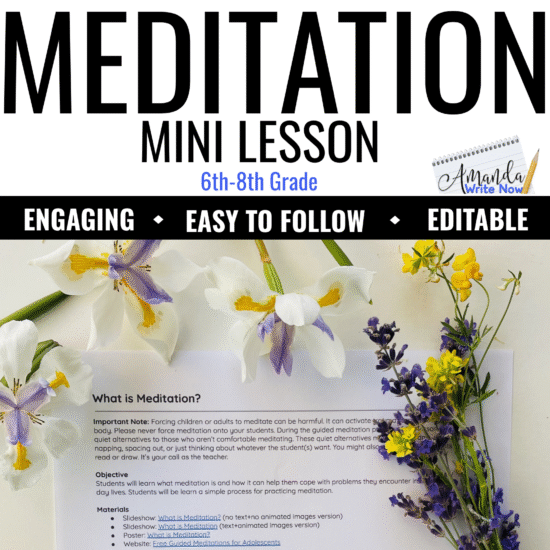
Meditation Mini Lesson 6th-8th Grade
$5.00 -
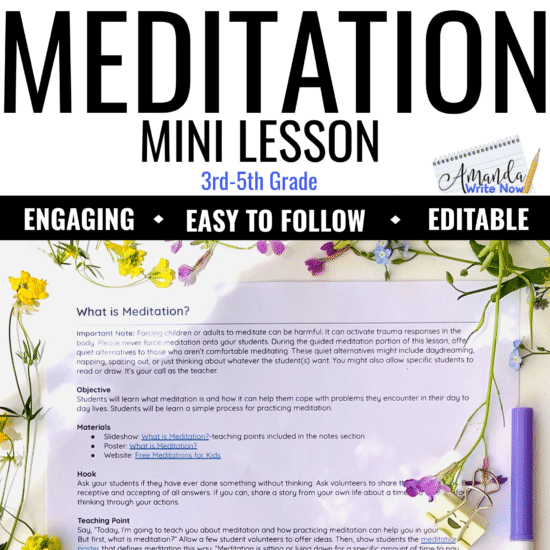
Meditation Mini Lesson 3rd-5th Grade
$5.00 -
Sale!

Middle School Engagement Bundle
Original price was: $212.50.$132.00Current price is: $132.00. -
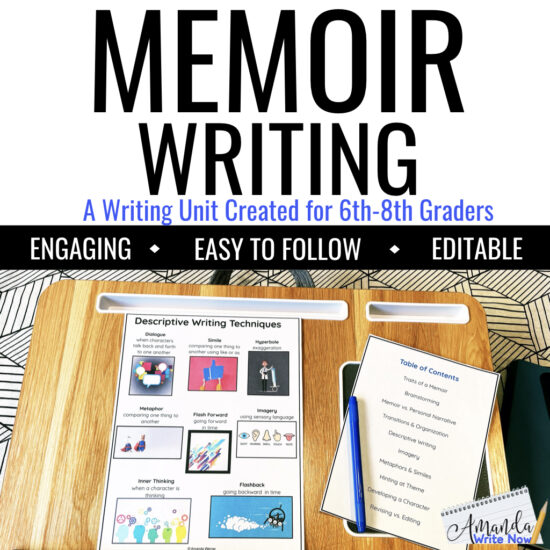
Memoir Writing Unit
$20.00 -

Journal Writing Unit
$15.00 -
Sale!
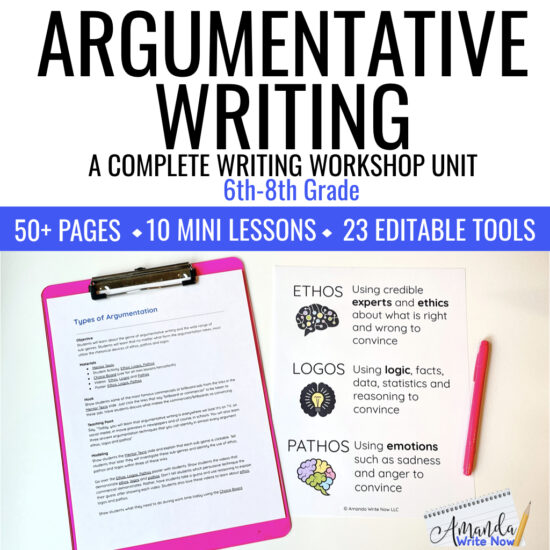
Argumentative Writing Unit
Original price was: $23.00.$18.00Current price is: $18.00. -

Digital Citizenship Posters
$2.25 -

Mafia Game
$6.00 -
How to Find a Good Book Mini Lesson
$2.75 -
Conferencing with the Teacher Mini Lesson
$2.75 -
Personalized Note Taking Mini Lesson
$2.75
Transcript
Amanda: [00:00:00] Hi. Today you are going to hear a 10 minute talk that I gave a year ago about the topic of compassion. And during the talk I, I got really emotional and I talked about why that’s a good thing and that I’ve learned more and more that my emotions, they’re. Signs from the inside. And as teachers, we don’t often turn inward.
We’re outward. We’re always taking care of our students, of our students’, parents, of our own families. And this program that I recently graduated from M-M-T-C-P. It’s an amazing [00:01:00] program and it was life changing. And during the program, I taught eight classes during a practicum experience, and I’m publishing them here on the podcast for you.
I think that I, they’re just really, really important, helpful, um, classes for burned out teachers really. You need this and I’m so happy that you found it. Um, this is actually part five in, uh, the eight parts series. If you want to listen to, uh, parts one through four. Just go back, uh, in your favorite podcast app and yeah, so you can go back and listen to the other classes anytime you want.
But this one, this one, I, I highly, highly recommend that you listen to the whole thing. Um, so the class is a recording and it’s outdoors. So that’s one thing I wanna warn you about. [00:02:00] The, the recording is. Is my, is the actual class that I taught. I thought it was, it was so good that I couldn’t replicate it, and I just wanted, wanted you to be able to hear it, um, raw and unedited and you’ll hear some background noise.
And then, uh, I actually, I, I rerecorded the guided meditation because, um, I just, I wanted to rewrite it a bit. It’s, it’s beautiful and I hope you enjoy it. And so there’s a 10 minute talk and then about a 13 minute guided meditation in this episode. And as always, if you appreciate the work that I’m doing, uh, I’d love for you to share it with a friend.
That would be wonderful. Uh, the more people know about it, the more. Uh, people are touched by this important work and, uh, you could also help me out by going to my [00:03:00] website, Amanda, right now.com and purchasing one of my resources I recently created. Mini lesson to teach kids about meditation, and it includes a guided meditation.
It’s really fun and silly, and it has some editable slideshows with some gif in it. And uh, there’s two different, there’s one for. Third through fifth graders, and there’s one through, uh, sixth through eighth. You could probably use it for ninth too. So you could go get that. Just go to the, the show notes or the description of this episode and I put a link to the meditation lessons in there.
I appreciate you and uh, thanks for listening and contact me anytime. Just go to Amanda right now.com and click contact and let me know what you think of this series all about meditation and mindfulness. I’d love to hear what you think and what you’re getting out of it. So let’s go ahead and, and get, get to the talk.
Welcome to the [00:04:00] Empower Students Now podcast. A podcast about equity, neurodiversity, mindfulness, and student engagement. There’s a lot that needs to change in our education system. The good news is teachers have the power to make these changes now.
So this talk is about compassion, and I have a quote to start off. It really, really, uh, resonated with me when I read it. It’s from a book called The Zen Teacher, written by a public school teacher, and it says, I was looking for someone to inspire me, motivate me, keep me focused. Someone who would love me, cherish me, make me happy.
And I realized that all along I was looking [00:05:00] for myself.
Self-compassion. And this is still from the book, Self-Compassion is an undervalued, under practiced art. That includes everything from forgiving yourself for perceived or actual mistakes, to practicing positive self-talk, such as affirmations, praise, pleasant thoughts, and well wishes.
And I mean, really compassion is kindness.
And I think what, what people have found is it’s really hard to be compassionate and kind to others if we’re [00:06:00] not doing the same for ourselves.
And so right now I just kind of want you to reflect. In your own mind using, you know, paying attention to your thoughts, uh, that come up when I ask you like, what percent of your thinking is tender and kind and forgiving towards yourself, like, how often do you treat yourself like you’re. You’re your own best friend,
like you’re nurturing yourself, holding yourself. How often do you do that? I,
[00:07:00] and when I reflect on this, I think about.
My childhood,
basically my entire life and trying to strive and achieve and that being what dominated my mind and how meditation and learning to notice. My top 10 hits, uh, really was the key to waking up to my own mind and the negativity that still lives there. It’s still there. It’s just because of practicing mindfulness and [00:08:00] being obsessed with this topic for so many years.
I’ve started to more easily, uh, be able to not get hooked on the negative thoughts about myself and the replaying of, of different things and, and how I maybe said the wrong thing and how maybe I hurt someone or feel guilty about something I did. Feeling like a bad person or like, I didn’t do enough. Uh, I, I notice that pattern.
It, it is part of my top 10 hits, and those voices are getting quieter because I’m not clinging to them and believing them as much as I used to. And there’s this acronym, uh, that I wanna teach you today that [00:09:00] Tara Brock. Uh. Uh, created for, uh, just this process called rain, and it’s a, it’s an easy ra, uh, acronym to remember, and I’m gonna kind of explain it to you.
So R stands for recognize, so recognizing that repeating pattern. Of negativity towards yourself or others, or any pattern for that matter. Uh, one of you mentioned, uh, feeling like you have a lot to get done and things aren’t getting done. That’s a, that’s a story. That’s a, that’s, that’s a, that’s something you can recognize.
Wow. Like I have this thought a lot like that. I’m. Getting behind. That’s a, that’s a pattern. There’s a pattern to that [00:10:00] thought. Um, and then allowing the experience to be there, just letting it be there. This is a thought that I’m behind or that I did something wrong, um, or I’m, I’m feeling bad about myself.
So just kind of allowing it, like seeing it, witnessing it being, taking the seat of the observer. So that’s a allow without judgment. And then I is investigate how does this thought feel? What does it do to your other thoughts? Um, and you’re, you’re just kind of interested like a scientist. You’re, you’re a little scientist kind of observing.
The physical sensations that happen in your body, what comes up for you when you [00:11:00] think that thought? What, what do you feel? You, maybe you feel your tensing up or maybe your, your stomach kind of hurts, or your heart starts to pound. Just starting to get in the practice of noticing. Um, and then in. It stands for nurture with self compassion, and so there’s a lot more to all of this and it’s pretty hard, honestly, like I’ve definitely, uh, I learned about rain, I don’t know, a year and a half ago, and personally.
I, um, I usually get to r like I recognize, but then I skip over allow, and the rest of it, uh, I might, I might go to [00:12:00] investigate. ’cause you know, I’m, I’m really, I, I still, we all have this conditioning of trying to fix, um. And so just the allowing is pretty hard. Um, it’s just allowing it to be there without judging it or trying to fix it or avoid it by like, kind of, um, numbing out or overworking or whatever your vices.
Uh, yeah. So, um. And when you investigate, you know, you could journal, you could think, uh, what is my answer to these questions? What most wants my in attention? Uh, what am I believing? What stories am I making up? What does this vulnerable place want from me? What does it most need? Uh, and then. When you bring in the self-compassion and the [00:13:00] nurturing, we have to recognize that in these stressful moments, these dysregulating moments, these moments of negativity in our mind of wanting to push things away, wanting things to be different, that we’re suffering, we’re in pain.
And we have to try and sense what’s wounded, what’s frightened, what’s hurting,
what do we need in that moment? Do we need forgiveness? Do we need a message of re reassurance? Do we need to put our hand on our heart and say, you’re doing the best you can.
Do we need love? Do we need to apologize to ourselves? [00:14:00] Do we need to say, I love you, I’m listening. It’s not your fault. Trust in your goodness
when the intention to awaken self-compassion is sincere. The smallest gesture of turning towards love, of offering love. Even if initially it feels awkward, will nourish your heart. And for me it often brings tears. And tears are a good thing I’m learning because they lower your cortisol, the cortisol that’s flowing through your body tears release and, and they’re really healthy.
And that’s not what we, we’ve been conditioned to, to know and to, to understand, huh? Right. We, we, we usually push tears away and, [00:15:00] and don’t want people to be sad and we think it’s negative. And I’m, I’m trying to practice this idea that tears are powerfully healing and that they’re a sign that I’m being compassionate.
To myself and others. So we’re gonna practice, uh, a med with a meditation, and, uh, this meditation is gonna walk you through rain with a difficult situation that you might be facing in your life. And again, if you have to tap out of this, if you have to kind of zone out. Or step, step away, walk away. You are that you are welcome.
Meditation is not the end all, be all. By the way. There’s like actual research that’s that’s happening right now, that it can actually be [00:16:00] bad for people if you meditate too much. Did you know that? Mm-hmm. Yeah. So, and, and yeah, like meditation, like in the past, like a decade ago. It was like, no, you sit there and you stay there.
Like you’re not a good meditator unless you like the Buddhist. Right? Yeah. And like today, like modern meditation is evolved to kind of incorporate trauma informed practices and so yeah, like it’s okay to get up, it’s okay to stop. Do you know what I mean? I, I’m just giving you permission. Thank you for being so cutting edge.
You are welcome. Appreciate it. Well, the program I’m in is cutting edge. Yeah. So that’s, that’s where this is all coming from. I appreciate it. Okay, let’s go ahead and start. So I will go ahead and, um, I’m just gonna ring the bell at the beginning and the end just, and what’s really great about this is you can kind of just, it directs your attention.
It’s an anchor, the noise. And I like to just listen to the [00:17:00] whole reverberation, like through the whole thing until I can’t hear it anymore. Yeah. So let’s begin our meditation.
Begin by finding a comfortable position, either sitting or lying down
as you come into stillness. Gently relax your eyes, close them if you feel comfortable or find a soft gaze.
Now, I invite you to direct your attention to your breath. To begin with, let’s breathe deeply in through the nose with a [00:18:00] slight hold at the top and out through the mouth like you’re blowing through a straw. Relax into this deep breathing pattern for a few silent moments.
Settle into this moment. If you notice, as you’re breathing deeply, distractions around you accept them, [00:19:00] realize they’re part of this moment, to
deepen into the sense that all is as it should be. There’s nowhere to go. There’s nothing to do except sit. Rely and listen to my voice and breathe deeply.
Anytime you notice your mind wandering or pondering, or judging or questioning, breathe, trust that you can bring your attention back. To your breath, always. If you remember, bring your attention back to your breath [00:20:00] into my voice. Continue breathing deeply.
No, allow your breath. To normalize, and I want you to at this point bring to mind a circumstance in your life where you feel in conflict with yourself, a situation that you feel a lot of judgment or negativity towards yourself.
Where in your life do you often have feelings of unworthiness, feelings of not being lovable or [00:21:00] respected feelings of I’m not. Okay.
A situation where you feel something is wrong. Or something has to change.
Try to choose something now. Whatever comes to mind or is most prominent,
you always have the option to get up and stop this recording. This is for you. To learn self-compassion. And so if feelings and, and this situation are too much, please, please take care of yourself.
But if you’re ready, we can continue to move on here. This circumstance will [00:22:00] most likely bring up hard feelings.
Recognize the physical sensations that are present. As you recall the situation,
this feeling of unworthiness. Notice the thoughts circulating in your mind. Notice the emotions that surface.
Pause right there
by noticing all that is here. Now when we’re calling this particularly hard situation, you are practicing the R in rain. Recognize.[00:23:00]
You recognize that you’re feeling low around this circumstance. You’re not feeling good about yourself without judgment. Simply observe what is coming up for you right now.
Whatever you sense, allow it to be there. If there’s tension, sadness, sorrow, uncertainty, neutrality, even distraction, word, joy. Breathe into what is here now, and maybe it’s a huge mixture of emotions and that too belongs. You don’t need to change it, fix [00:24:00] it, or avoid it. You might even right now whisper to yourself.
Yes, I allow these hard feelings. I allow this moment. Feeling this too. I accept the reality of the circumstance. What we’re doing here is practicing the A in rain allow, so we recognize what’s happening in our bodies and our minds and we allow it.
The I in REIGN stands for investigate. With a curious mind and a caring heart, let’s investigate your inner experience surrounding the circumstance. Ask yourself, what is coming up for [00:25:00] me here?
Is there something I’m resisting? How am I experiencing this in my body? What narratives or stories or beliefs am I getting pulled into? What am I believing about myself? Is it that maybe you did something wrong, that you aren’t doing enough, that you aren’t respected, that you’re invisible or something else?
Notice the feelings and how they change and increase. When you believe these thoughts
continue breathing in through the nose and out through the mouth. If the intensity of these feelings, [00:26:00] it is too much. You can bring your attention back to the breath. Always remember to approach your inner world with gentleness. Avoid judgment. Dive deep into the felt senses of your body right now. What are you observing
as you observe, continue breathing. If you have to take some deep breaths, do that
now. We will enter into the end of rain. Nurture
Connect with the part of you that needs attention. What does it most need?
Perhaps it’s a whispered message of reassurance. [00:27:00] Love, understanding. Try whispering to yourself. I’m here for you. I love you. It’s going to be okay.
If it feels right, you might place a hand over your heart. Or on your cheek, feel the warmth and connection that is always there for you in every moment.
Maybe you can, at this point repeat a mantra that resonates most with you. It could be I am whole, I am enough. I am loved or something else of your choosing. [00:28:00] Rest into this mantra for a few moments of silence.
Now as we. Close this practice. I’d like you to visualize this. Imagine a radiant light or a loving figure enveloping you, holding you, offering you all the love and care you need.[00:29:00]
Absorb this warmth and kindness,
rest in the awareness of your own presence and warmth and loving kindness.
Imagine what your life would be like if you didn’t get caught in this negativity towards yourself. And these limiting thoughts and emotions feel the spaciousness. The freedom from the tight grip of the negative beliefs and emotions around the circumstance bask in the realization that you are more than any fleeting thought.
Or emotion
you have touched upon the natural freedom of your [00:30:00] being.
Now, slowly begin to deepen your breath.
Feel the ground beneath you.
Notice any noises in your environment,
you might wiggle your fingers and toes.
Give them some attention,
and when you’re ready, you can gently open your eyes. You carry the wisdom and compassion you’ve cultivated in this meditation with you knowing that you can return to rain anytime you [00:31:00] need. It’s so powerful how simply being with our own experiences with a kind and open heart can radically transform our relationship with ourselves and our life.
Circumstances. Thank you for taking the time to take care of your [00:32:00] heart.
0 Comments